How to Automate Pallet Welding? Using a Hot Plate Welding Machine.
Equipemt Application Case —— Huazhuo Automation Group Equipment Application Case (China)
Case Background
Hot plate welding is a well-established plastic welding technology widely used in automotive interior and exterior parts manufacturing, such as storage boxes, water tanks, oil reservoirs, glove boxes and flow channel plates. In recent years, this technology has also been increasingly applied to plastic pallet welding, especially for heavy-duty and reinforced pallet structures.
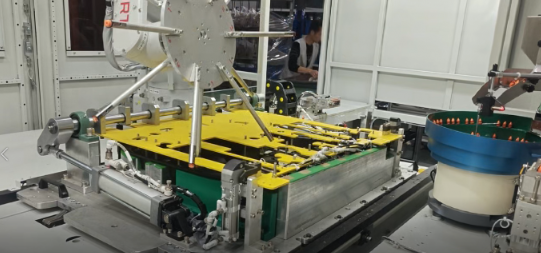
The pallet hot plate welding machine is an automated welding system designed for thermoplastic pallets and large flat plastic components, achieving high-strength and well-sealed joints through hot plate heating, pressing, and controlled cooling.
Equipment Overview
The system is customized according to pallet size and material characteristics. By adjusting the positioning and limit plates, the same machine can accommodate pallets of different dimensions.
Key Features
Large welding area, suitable for oversized flat components
High welding strength, with joint strength close to or equal to base material
Excellent sealing performance, suitable for load-bearing, waterproof and dustproof pallet structures
Stable process for thick-wall and reinforced plastic designs
Applicable Materials
PP/PE/HDPE/ABS,etc
The system is particularly suitable for thick-walled and structurally reinforced pallets.
Case Machine Specifications
Model: HZ-RB2000
Overall Dimensions: L 7700 mm × W 4900 mm × H 2500 mm
Machine Weight: 5 tons
Applicable Pallet Size Range: 1000 × 1000 mm to 2000 × 2000 mm
The machine is fully customized based on product material, size and structural design.
Application Results
After implementation, the pallet manufacturer achieved:
Stable welding quality for large-size pallets
Improved structural strength and sealing reliability
Reduced manual intervention and rework
Better consistency across different pallet sizes
This solution provides a reliable welding method for high-strength plastic pallets used in logistics, warehousing and industrial transportation.
Automotive Plastic Parts Surface Treatment Machine —— Huazhuo Automation Group Equipment Application Case (China)
Case Background
In China’s automotive interior and exterior parts manufacturing industry, plastic components made of PP, PE and other low-surface-energy materials are widely used for trims, pillars, storage boxes and decorative panels. Before painting or adhesive bonding, stable and reliable surface activation is a critical process step to ensure coating adhesion and bonding strength.
To meet different production requirements, the customer introduced two types of automotive plastic surface treatment machines: Flame Surface Treatment Machines and Plasma Surface Treatment Machines, which are applied according to product structure, production rhythm and quality requirements.
Solution 1: Flame Surface Treatment Machine
The flame surface treatment machine uses a controlled flame to rapidly heat and oxidize the plastic surface. This process modifies the molecular structure of the surface layer, increases surface tension, and significantly improves the adhesion of coatings and adhesives.
This technology is mature and stable, and is widely used in pre-treatment before gluing or painting of automotive interior and exterior plastic parts.
Key Advantages
Fast processing speed and high efficiency
Simple equipment structure with low maintenance cost
Particularly effective for low surface energy materials such as PP and PE
Suitable for high-volume, standardized production lines
Typical Application
Automotive interior trims before adhesive bonding
Exterior decorative parts before coating
Large batch production with stable product geometry
Solution 2: Plasma Surface Treatment Machine
The plasma surface treatment machine activates plastic surfaces using plasma discharge, effectively removing surface contaminants and increasing surface energy without direct contact. The system can be configured as a robot-mounted plasma unit or a chamber-type (box) plasma system, depending on the application.
Plasma treatment is commonly applied in critical pre-gluing processes, where high bonding consistency and clean processing are required.
Key Advantages
Non-contact surface activation, minimal impact on material properties
Uniform and consistent treatment quality
Flexible robot paths for complex 3D surfaces
No chemical solvents, environmentally friendly and VOC-free
Comparison: Flame vs. Plasma Surface Treatment
Item
Flame Surface Treatment
Plasma Surface Treatment
Treatment Principle
Controlled flame oxidation
Plasma activation
Processing Speed
Very fast
Medium to high
Surface Uniformity
Good
Very high
Suitable Materials
PP, PE, low surface energy plastics
Most thermoplastics
Product Geometry
Simple to moderately complex
Complex 3D surfaces
Equipment Complexity
Simple
Medium to high
Maintenance Cost
Low
Medium
Environmental Impact
Open flame, ventilation required
No VOC, clean process
Plasma System Configuration Options
Robot-mounted plasma system: Suitable for large, complex 3D automotive parts such as pillars and trims
Chamber (box-type) plasma system: Suitable for small to medium-sized parts requiring batch processing and high consistency
Application Results
By selecting the appropriate surface treatment technology based on product structure and production needs, the customer achieved:
Improved adhesive bonding reliability
More stable coating quality
Reduced rework caused by poor adhesion
Better adaptability to different plastic materials
This flexible combination of flame and plasma surface treatment provides a reliable solution for automotive plastic parts manufacturing Factory.
1. Project Background
In automotive interior manufacturing, wrapping processes are widely used for dashboard trims, door panels, and A/B/C pillar interior parts.In this project, the customer produces both stitched and non-stitched interior components. During mass production, the original process showed poor consistency and a high rejection rate.
2. Customer Pain Points
Stitching misalignment after wrapping, affecting appearance quality
Same process used for stitched and non-stitched parts, causing instability
Heavy dependence on operator experienc
Difficult to balance cycle time and quality in automated production
(Non-Stitched Component)
(Stitched Interior Component 1)
(Stitched Interior Component 2)
3. Non-Stitched Parts Covering Process
Process Flow
Adhesive spraying → Drying →Heat pressing+ Automatic wrapping → Trimming
For non-stitched automotive interior parts, the key focus is surface adhesion and edge wrapping quality. Since there is no visible stitching, the material can be directly processed by the automatic wrapping machine.
4. Stitched Parts Covering Process (Key Difference)
Process Flow
Adhesive spraying → Drying → Pre-wrapping alignment → Heat pressing+ Automatic wrapping → Trimming
Pre-Wrapping Alignment Station (Critical Process)
For stitched interior parts, a pre-wrapping alignment station is added before the automatic wrapping process. The stitching is accurately aligned with the product reference line and fixed in advance, preventing displacement during wrapping.
5. Key Process Considerations
Stitched parts should not skip the pre-wrapping process
Mold pressure must be optimized around stitching areas
Different process programs should be used for stitched and non-stitched parts
6. Project Results
Significantly improved stitching alignment consistency
Reduced rejection rate
Stable cycle time with higher automation
Standardized process, easy to replicate for other projects
7. Solution Summary
By customizing the covering process based on product structure, this project delivers a one-stop automotive interior wrapping machine solution, effectively solving the key challenges of stitched parts in automated production.
For more information about similar automotive interior wrapping solutions, please visit the official website of Huazhuo Automation